Homepage SEO: How to Write a Homepage Google and AI Understand
Good homepage SEO starts with one simple rule. The short answer: your homepage should say what you do, who it’s for and where you are, in plain words, near the top. Then put the same facts in your page title and meta description. After all, Google and AI assistants like ChatGPT can only recommend you for what your website clearly says.
We’ve built websites for more than 300 women-owned businesses, and this is the most common problem we see. The site is gorgeous. The photos are stunning, too. And yet nowhere does it say, in plain words, what the business does or where.
Of course, people can figure it out from your photos. Google and AI mostly can’t, because they read words.

The three questions good homepage SEO answers
Within the first screen of your homepage, a stranger (or a robot) should be able to answer:
- What do you do? “Wedding photographer,” not “storyteller.”
- Who is it for? “Couples planning a mountain elopement,” not “dreamers.”
- Where are you? “Boise, Idaho, and the Treasure Valley,” not “wherever love takes me.”
Still, you can keep the poetry. Just put the plain answer next to it.
Homepage SEO before and after: three examples
We made these businesses up, but the fixes are real.
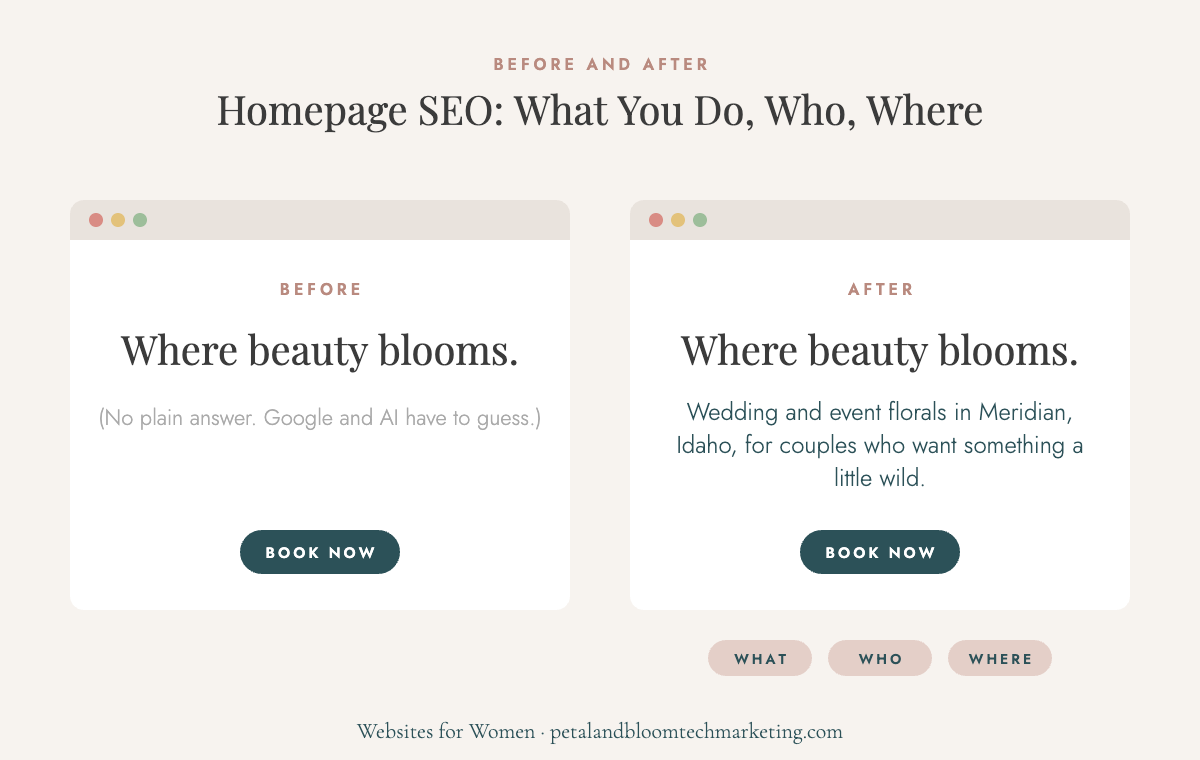
Florist
- Before: “Where beauty blooms.”
- After: “Where beauty blooms. Wedding and event florals in Meridian, Idaho, for couples who want something a little wild.”
Salon
- Before: “Your best self starts here.”
- After: “Your best self starts here. Lived-in color, balayage and curly cuts in downtown Eagle, Idaho.”
Business coach
- Before: “Unlock your potential.”
- After: “Business coaching for women-owned service businesses ready to grow past $250K. Virtual, worldwide.”
Notice the pattern: service + who + where. That one sentence does more for your homepage SEO than any plugin.
Fix your homepage title (the most important 60 characters)
First, your page title is the blue link people see in Google. It’s also one of the first things AI reads about a page, so it carries a lot of weight. Unfortunately, many platforms default to something useless like “Home.” Google explains how it picks the link text in its title link guide.
Use this formula: [What you do] in [Where] | [Business name]
| Before | After |
|---|---|
| Home | Studio | Wedding Photographer in Austin, TX | Rose Lane Studio |
| Welcome! | Wedding Florist in Meridian, ID | Wild Stem Floral |
| Jane Smith | Business Coach for Women Founders | Jane Smith |
Keep it under about 60 characters so Google doesn’t cut it off. Also, every page on your site should have its own title. In other words, don’t copy the same one everywhere.
Write a meta description that answers the search
The meta description, another piece of homepage SEO, is the short paragraph under the link in Google. So write one or two sentences that say what you do and why someone should click. For example, aim for about 150 characters. Google’s snippet guidelines have more examples.
Example: “Wedding and event florals in Meridian, Idaho. Organic, garden-style designs for couples who want something a little wild. Now booking 2027.”
Use real headings for homepage SEO
Set the big text on your page as real headings (H1, H2, H3), not just big fonts. That’s because headings are how Google and AI understand the outline of your page.
- One H1 per page, and it should include your main service.
- H2s for each section, like “Wedding florals,” “Event florals” and “How booking works.”
- In Showit, Squarespace and Wix, you pick heading levels from the text style menu.
Add a services section in plain words
Next, list each service with a sentence or two about what’s included. Also, if you serve several towns, name them. Likewise, if you have starting prices, say so. AI assistants love a clear answer to “How much does it cost?”
Answer the questions clients ask you
Similarly, add a short FAQ to your homepage or services page. Use the exact questions clients ask you on discovery calls:
- “Do you travel for weddings?”
- “How far in advance should I book?”
- “What’s your starting price?”
That way, when someone asks ChatGPT the same question, a page that answers it directly is easy to quote.
Put your contact details in text
For local homepage SEO, your business name, town, phone number and email should appear as real text, not only inside an image or a contact form. Then make them match your Google Business Profile exactly, because AI compares the two.
Homepage SEO quick checklist
- ☐ The first screen says what I do, who it’s for and where
- ☐ My page title follows “service in place | business name”
- ☐ My meta description answers the search in one or two sentences
- ☐ I have one H1 and real H2 headings
- ☐ I describe each service in plain words
- ☐ My FAQ answers real client questions
- ☐ My name, town and contact details are text and match Google
This is Step 2 in How to Get Recommended on ChatGPT. If you haven’t yet, first make sure your website isn’t blocking ChatGPT. For salon owners, our guide to salon website design goes deeper on booking pages.
Homepage SEO: frequently asked questions
No. You can keep your tagline and layout. Just add one clear sentence under it.
List your main town and the nearby areas you actually serve. However, don’t list places you don’t work.
Usually a few weeks. You can speed it up by requesting indexing in Google Search Console.
Want the exact words for your site?
The Visibility Fix reads your website and shows your current wording right next to suggested new wording, with the exact spot to paste it in Showit, WordPress, Squarespace, Wix or Shopify. $27 a month, cancel anytime. Want a new homepage built this way from day one? See our custom website design.
Leave a Reply

© 2024 Petal & Bloom Tech Marketing | All Rights Reserved
